
The Hidden Cost of Ignoring Your Dock Doors
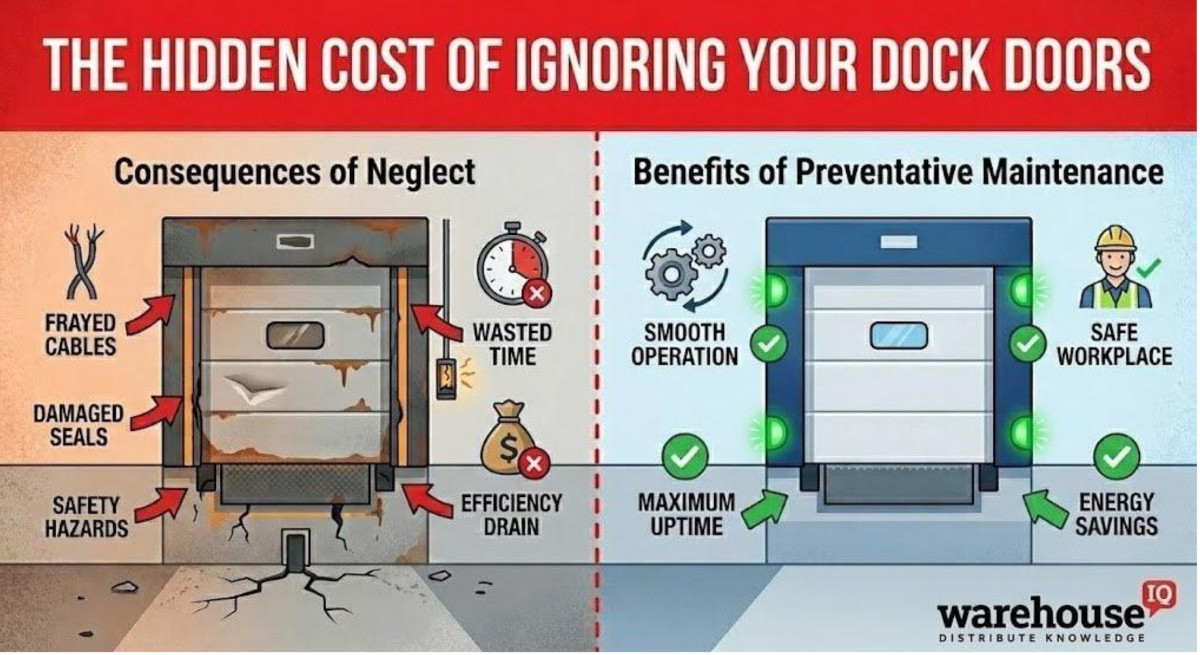
The Hidden Cost of Ignoring Your Dock Doors
Every warehouse, distribution center, and retail backroom has its own rhythm. You might be running a highly customized inventory system or managing a massive material handling fleet, but there is one universal chokepoint every logistics professional shares: the dock doors.
They are the gateway to your revenue. If your doors aren’t moving, neither is your product.
Over the years, we’ve noticed that facility managers typically approach their loading zones with one of three mindsets.
- The Safety-First Manager: You're always watching out for your guys and the drivers bumping the dock. You know that a door that sticks or a plate that won't sit flush is more than just a daily annoyance. It's an accident waiting to happen. You run a tight ship with regular maintenance because a slipped load or an avoidable injury is your worst-case scenario.
- The Equipment Protector: You hate watching your gear get trashed. Seeing a ripped dock seal, dead guide lights, or crumbling concrete actually bothers you. You know that letting the building take a beating every single day just ends up wrecking your lifts, the docks, and the trailers backing into them.
- The Output Optimizer: You lie awake calculating how to shave seconds off your turnaround times. To you, a five-minute delay per truck might seem trivial to an outsider, but you know it compounds into a massive efficiency drain over hundreds of loads. A driver idling in the yard due to a jammed door is completely unacceptable.
So, What's Your Game Plan?
It doesn't really matter which camp you fall into. The real issue is how you're actually handling the upkeep out on the dock.
Usually, operations fall into one of three habits:
- The Proactive Approach: You have a professional maintenance team on a regular schedule to keep things running smoothly year-round without you having to think about it.
- The DIY Approach: You ask your in-house team to handle the quick fixes as they pop up, crossing your fingers that their general know-how is enough to safely work on a commercial door.
- The "Cross Your Fingers" Approach: You run the doors until they break. Maintenance is a nice idea, but with a hundred other daily fires to put out, it never makes the schedule—until a door gets stuck.
If your operation relies on the DIY or "cross your fingers" method, it’s time to re-evaluate. Losing even one dock door brings your workflow to a grinding halt. If you're just crossing your fingers and hoping for the best, it's going to catch up with you. Here is exactly what happens when you skip routine maintenance:
1. Cheap Fixes Turn Into Massive Bills
A ripped seal, a dead guide light, or a tiny crack in the concrete doesn't seem like a big deal on a Tuesday afternoon. But when you run heavy volume, those little things get worse fast. A frayed cable turns into a snapped line right in the middle of a shift. A track that's slightly out of whack eventually burns out the whole motor. Paying for a quick adjustment now is basically pocket change compared to the emergency service fees and complete door replacements you'll be dealing with down the road.
2. Safety Becomes Compromised
A dock door is a heavy, high-tension piece of industrial machinery. When springs wear out or tracks bend, the risk of a door failing—or a forklift tipping due to improper alignment—skyrockets. Routine expert inspections catch these invisible hazards before they result in catastrophic injuries to your warehouse team or visiting drivers.
3. Efficiency Plummets
When a driver has to spend an extra five to ten minutes fighting a stubborn door, repositioning because of bad lighting, or dealing with a broken leveler, your throughput tanks. Multiplying that wasted time by thousands of annual loads reveals a massive loss in productivity. A quick, scheduled tune-up prevents hundreds of hours of logistical bottlenecks.
4. The In-House DIY Trap
Your warehouse crew is incredibly capable, but taking them off their primary duties to troubleshoot a specialized commercial door is a poor use of their time. Plus, when your own guys do the work, you usually miss out on the paper trail. If an inspector shows up or a warranty claim pops up, you need documented proof from certified techs. Let the pros handle the heavy mechanical work so your crew can focus on what they actually get paid to do—moving freight.
5. You Frustrate Your Carriers
Drivers talk. To them, your loading zone is your business. If they pull up to a bay with a busted leveler or a door that won't clear the trailer, you're just messing with their time. Keep that up, and your facility quickly earns a reputation as a bottleneck. Drivers will hate coming to your yard, and your logistics partners will start treating you like a headache.
It is incredibly easy to let door maintenance slide when you have a hundred other fires to put out on the floor every single day. But your facility only thrives when product can actually move smoothly. Instead of waiting for a cable to snap or a track to bend—and dealing with the sudden stress of an emergency shutdown—give yourself some peace of mind. Bringing in a pro for routine check-ups takes the burden off your crew, keeps your drivers happy, and ensures your loading zone stays safe and predictable.
Please log in to leave a comment.
No Comments Yet